Insights & Trends
Enabling spatial reasoning for LLMs
Aleksandra Kovacevic — 16 June 2026
6 min read
16 December 2025
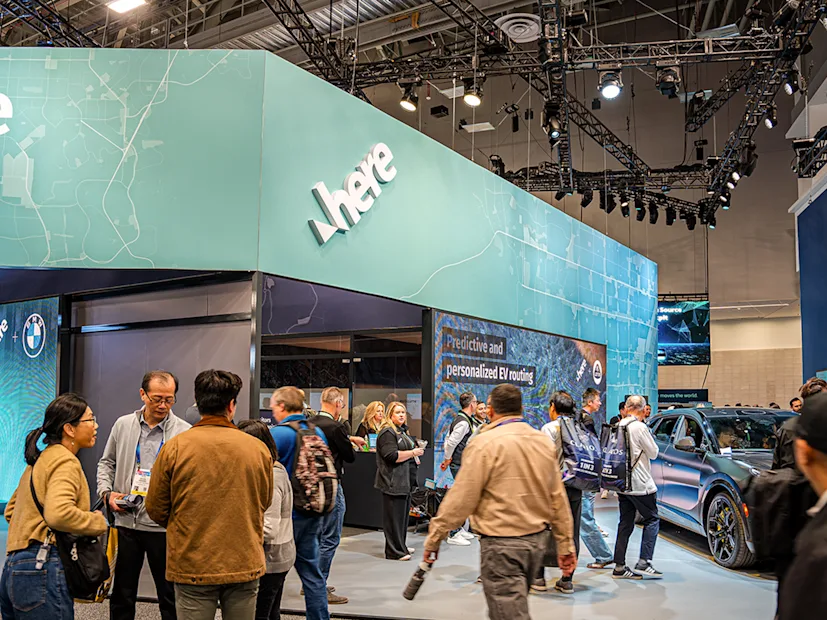
Something in the CES air feels different—sharper, more focused, a little more ambitious.
Maybe it’s the collective reset across the tech world, maybe it’s the automotive and logistics industries finally shaking loose from old hardware-first habits, but the possibilities suddenly feel wide open again. Nowhere will that energy be more visible than at CES 2026 in Las Vegas this January.
Instead of treating software, sensors and artificial intellignece (AI) as quiet upgrades, exhibitors will use them as bold statements: agentic AI stepping into real-world autonomy, software-defined vehicles (SDVs) evolving into adaptive computing platforms and location intelligence transforming from raw data into a decision-making engine for entire ecosystems.
The result? HERE at CES 2026 will be defined by location-aware agentic systems, EVs and fleets that behave like upgradable software platforms, and location tech that turns every movement into real-time intelligence. Below, explore the biggest AI-driven mobility and logistics trends automakers and tech giants will be embracing next year.
Instead of relying on fixed systems, software-defined vehicles can get updates the way your phone does—improving everything from how they steer to how safely they can react on the road. With AI helping them learn and adapt, these cars feel more intuitive, safer and smoother to drive, setting an emerging standard for what we expect from modern vehicles.
With a new industry framework co-developed by HERE Technologies and Omdia, automakers now have a clear roadmap to navigate the shift from connected cars to intelligent, agentic systems. As greenfield OEMs in markets like China race ahead, the message is clear: adapt now or risk being left behind in a rapidly evolving automotive landscape.
"If you don’t know where you are in the SDV journey, it’s hard to define your strategy," said Maite Bezerra, Senior Principal Analyst at Omdia, underscoring the urgency for automakers to embrace software-defined vehicles.
Navigation on Autopilot (NOA) acts as an intelligent co-pilot by linking a car’s navigation route, defined by detailed digital maps, with systems like adaptive cruise control and lane-keeping for smarter, more coordinated driving.
Unlike typical driver-assistance features where you handle navigation decisions, NOA allows the car to follow its planned route, automatically managing lane changes, interchanges and speed adjustments for curves, all while keeping you in control and attentive to the road.
“The trend toward NOA is moving the industry in the direction of HERE’s ‘sweet spot’—the place where our unified layers of location data, including accurate, regularly updated and high-definition digital maps come together with automated driving systems,” said Gino Ferru, Senior Vice President at HERE.
Today, location-based tasks require piecing together multiple tools and manual effort, like finding a peaceful café with outdoor seating and an EV charger halfway along your route.
With agentic AI, you simply state your needs in natural language, and the agent proactively handles the complexity whether it’s re-routing trucks to avoid low-clearance bridges or prioritizing EV-friendly stops.
HERE is uniquely positioned to support this transition. With advanced mapping and AI tools like the HERE AI Assistant, companies can embed real-time location intelligence into everyday operations, improving decision-making, optimizing routes and reducing operational friction.
“In the agentic era, maps must provide reasoning that LLMs can use, giving agents location intelligence they can understand and act on,” said Aleksandra Kovacevic, Senior Director of Responsible AI at HERE.
With parcel delivery volumes skyrocketing every year, the last mile remains a top priority for cutting costs and keeping customers happy. For Bart Coppelmans, Senior Director of Product Management at HERE, last-meter precision is key—getting packages not just to the right address, but to the exact spot the customer wants them.
“It’s not enough to deliver to an address,” Coppelmans explained. “Precision means ensuring packages reach the exact unit in an apartment complex, the correct locker or a specified safe place.”
Meeting that level of accuracy increasingly relies on AI and real-time data. According to Coppelmans, while these technologies aren’t new, their applications are getting smarter and more critical to everyday operations.
“AI is opening up new opportunities in logistics, but many companies are still in the early stages of figuring out how to apply it,” he said. “Our focus at HERE is to help them bridge that gap, integrating AI-driven tools for planning, routing and execution so we can innovate together and turn emerging technologies into practical, real-world improvements.”
And it’s not just about planning. With the capabilities underpinning the HERE AI Assistant, Coppelmans envisions integrating these tools directly into drivers’ workflows, especially for last-mile delivery. The goal? To create what he calls “consistency between planning, execution and analytics” in real time.
“We’re exploring how AI can orchestrate complex logistics tasks end-to-end, turning massive datasets into actionable insights—whether it’s finding the best parking spots or predicting, avoiding and better managing unexpected delays,” said Coppelmans.
Find us in the West Hall at the same great location as last year, booth number 3501.
Experience the future of location technology firsthand. Connect with our experts, see live demos and discover how HERE is pioneering the next generation of mobility, logistics and in-car experiences.

Louis Boroditsky
Managing Editor, HERE360
Share article
Aleksandra Kovacevic — 16 June 2026
Louis Boroditsky — 27 May 2026
HERE Technologies — 20 May 2026
Why sign up:
Latest offers and discounts
Tailored content delivered weekly
Exclusive events
One click to unsubscribe